 BestPriceDeal.in
The Core Philosophy: “Digital at the Core”
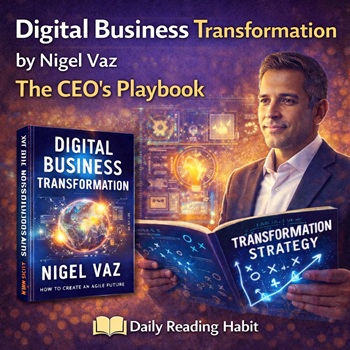
The most significant takeaway from Vaz’s work is the distinction between digitizing and digital transformation.
Digitization is the act of taking an analog process and making it digital (e.g., turning a paper form into a PDF). Digital Business Transformation (DBT), however, is about reimagining the business model itself through the lens of what is now possible with technology. Vaz argues that for established companies to survive, they must build a “digital moat”—an integrated set of capabilities that are wide, deep, and difficult for competitors to breach.
1. The Four Forces of Connected Change
Vaz begins by identifying why the “business as usual” era is dead. He points to four overlapping forces that are accelerating the need for change:
-
Customer Behaviors: Rising expectations driven by tech-native giants.
-
Technological Change: The exponential growth of AI, cloud, and edge computing.
-
Business Models: The shift from selling products to providing platforms or services.
-
Societal Change: Changing values regarding privacy, sustainability, and ethics.
2. The SPEED Framework: Five Modern Capabilities
The heart of the book is the SPEED framework, an acronym for the five integrated capabilities that Vaz believes define a digital company. Rather than working in silos, these five areas must work concurrently:
| Capability | Definition & Role |
| Strategy | Moving away from competitor-focused strategy to customer-centric hypotheses. |
| Product | Shifting from project-based “delivery” to continuous product evolution. |
| Experience | Creating value across the entire customer journey, not just a single interface. |
| Engineering | Building the technical “promise” at scale and pace. |
| Data | The “non-negotiable” asset used to validate hypotheses and uncover insights. |
3. The D-3 Model: Defend, Differentiate, Disrupt
Vaz provides a strategic roadmap for decision-making called the D-3 Model. This helps leaders decide where to allocate resources:
-
Defend: Optimizing existing markets and protecting your current customer base.
-
Differentiate: Using digital to enter new markets or provide a superior experience that sets you apart.
-
Disrupt: Creating entirely new business models or ventures that solve problems in fundamentally new ways.
4. The “Gryphon” Organization: Leading the Hybrid
Vaz uses the metaphor of a Gryphon—the mythical creature with the body of a lion and the head of an eagle—to describe the ideal established business. It must have the “lion” (the strength, scale, and assets of an established firm) and the “eagle” (the speed, vision, and agility of a digital native).
5. Critical Analysis: Strengths and Weaknesses
Strengths:
-
Actionable Clarity: The book is a practical manual for C-suite leaders who are tired of high-level theory.
-
Holistic View: It correctly identifies that culture and organization are just as important as the code being written.
-
Authority: Nigel Vaz writes with the weight of someone who has actually implemented these changes at global firms like Goldman Sachs and McDonald’s.
Weaknesses:
-
High-Level Perspective: Middle managers might find some of the concepts difficult to apply without strong top-down support.
-
Jargon-Heavy: While it seeks to simplify, it still relies on “corporate-speak” that might feel repetitive for those already well-versed in digital strategy.
6. Final Verdict: A Mandatory Read for Modern Leaders
Digital Business Transformation is not just another business book; it is a survival guide. Nigel Vaz successfully argues that the “muscle of continuous change” is the only sustainable competitive advantage in an era where technology moves faster than human planning.
Our Rating: 4.7/5 Stars